Welcome to the official website of Guangzhou Sanxin Metal Technology Co., Ltd.!


Spray coating processing SPRAY PROCESSING
![[Coating Preparation] Erosion-Resistant Coating](/npublic/img/s.png "[Coating Preparation] Erosion-Resistant Coating")
[Coating Preparation] Erosion-Resistant Coating
[Coating Preparation] Erosion-Resistant Coating To achieve an ideal sealing condition between the blades and the casing of high-speed rotating machinery (such as compressors and gas turbines) and thereby maximize the hydrodynamic pressure differential, erosion-resistant coating technology can be employed to enhance overall machine efficiency, reduce energy consumption, and extend service life.
火焰粉末喷涂
Product Description
To achieve an ideal sealing condition between the blades and the casing of high-speed rotating machinery—such as compressors and gas turbines—and thereby maximize the hydrodynamic pressure differential, wear-resistant coating technology can be employed to enhance overall machine efficiency, reduce energy consumption, and extend the service life of the entire unit. In aeroengine manufacturing, the use of wear-resistant coatings has successfully reduced the clearance between the rotor and the engine casing. Regarding the clearance control between the compressor turbine and the outer ring, the ideal outcome is that friction does not cause damage to the turbine or other compressor components, such as bearings or gears. After friction occurs, the surface of the wear-resistant coating must be exceptionally smooth, with no transfer of coating material onto the turbine. If the residual surface remains rough, it will negatively affect airflow guidance, thereby reducing machine efficiency. Moreover, if wear-resistant material transfers onto the turbine, it could lead to imbalance, also impacting the compressor’s performance. To date, a series of wear-resistant coating materials have been developed specifically for addressing air-path sealing issues in jet engines. The application of wear-resistant coatings is not only suitable for surface air-sealing areas to minimize clearance but can also be used in labyrinth seals to channel cooling air, reduce compressed-air losses in the engine, and maintain pressure balance along the rotor shaft.
In addition to the earlier practice of using flame-sprayed pure aluminum coatings as wearable coatings, most of the wearable coatings currently in use consist of two components: a metallic matrix and a non-metallic filler. The purpose of the filler is to reduce the overall integrity of the metallic matrix and enhance the wear resistance of the coating. The spray powders used for wearable coatings are either mixed powders composed of these two materials or agglomerated powders.
By employing plasma spraying or powder flame spraying techniques, a soft, wear-resistant coating is applied to the compressor casing, while a hard, wear-resistant cobalt-bonded tungsten carbide coating is sprayed onto the tips of the compressor blades. This approach creates an ideal controlled sealing gap between the two components. This advanced manufacturing technology, which rapidly developed in the aerospace sector during the 1970s, represents one of the key applications of modern thermal spray technology.
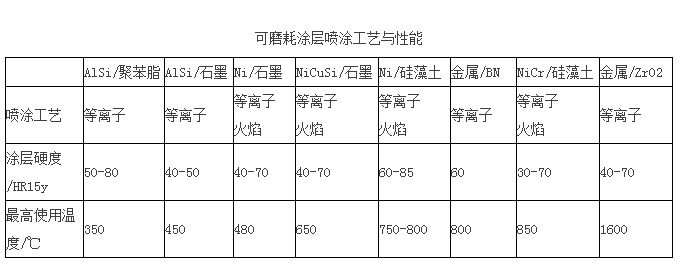
1. Selection of wear-resistant coatings
In practical applications, the selection of wear-resistant coatings is primarily based on two factors: first, the ambient operating temperature; and second, the required coating hardness. The hardness, maximum service temperature, and spraying processes used for commonly employed wear-resistant coatings are shown in the table below.
2. Preparation of Wear-Resistant Coatings
The methods for preparing wear-resistant coatings mainly include flame spraying and plasma spraying. In practical applications, the choice of method should be guided by the powder supplier’s recommended approach or determined through experimentation. The parameter settings for spraying nickel-coated graphite wear-resistant coatings using Praxair’s FP-73 flame powder gun are shown in the table below.

The properties of wear-resistant coatings are not only closely related to the composition of the powder but also vary significantly with changes in spraying parameters. Once the spraying process has been established, it must be strictly controlled, as this is crucial for ensuring coating quality. For wear-resistant coatings, hardness is one of the key parameters that significantly affects coating performance and must be rigorously controlled.
The specimens for hardness testing using wear-resistant coatings require special preparation. First, the coating thickness must meet certain requirements; if the coating is less than 2 millimeters thick, it will lead to inaccurate hardness measurements. Second, the measurement surface must be smooth—ideally, it should be gently polished with 60-grit silicon carbide dry sandpaper. Excessive grinding pressure can result in inaccurate hardness readings, and the surface roughness should be controlled within an Ra of 6 to 9. Third, the hardness measurement must be performed using a standard surface hardness tester, selecting a 12.7-millimeter steel ball and a 15-kilogram load, with the hardness reading expressed as HR15Y.
In a study on wear-resistant coatings for the compressor turbine and outer ring of an all-gear-driven compressor, it was found that none of the five wear-resistant coatings used resulted in excessive machine load due to friction. However, the Ni-coated graphite (85-15) wear-resistant coating applied by flame spraying caused damage to the edges of the turbine blades and led to discoloration in localized areas, resulting in severe turbine damage. On the other hand, the AlSi/40 wt% polyester, AlSi/50 wt% polyester, and AlSi-BN/polyester wear-resistant coatings applied by plasma spraying exhibited coating material transfer, with coating materials migrating to the edges of the turbine blades and forming spatter deposits. Moreover, when the AlSi-BN wear-resistant coating applied by plasma spraying had a hardness exceeding 60 HR15Y, coating material transfer to the turbine blade edges also occurred; however, when the hardness was below 60 HR15Y, no such transfer phenomenon was observed. Furthermore, after friction, the surface of the outer ring coating remained smooth and free of defects, which facilitated the smooth guidance of compressed airflow and did not affect the dynamic balance of the entire machine. Thus, this coating fully meets the gap-control requirements between the compressor turbine blades and the outer ring.
When preparing wear-resistant coatings, special attention must be paid to the following: Before spraying each part, a trial spray should be conducted first, and the hardness of the trial specimen should be tested. If the coating’s hardness meets the requirements, it indicates that its wear resistance performance will also meet the standards; only then can the parts be sprayed. If the coating’s hardness does not meet the requirements, the spraying process must be adjusted accordingly. For flame spraying, one method to adjust hardness is to change the powder feed rate while keeping the gas flow rate, spraying distance, and gun-moving speed constant. Reducing the powder feed rate will increase the coating’s hardness, whereas increasing it will decrease the hardness. The powder feed rate should be adjusted incrementally, with the coating hardness being checked after each adjustment until the desired hardness is achieved. Another method is to adjust the flow rates of oxygen and fuel gas while keeping the powder feed rate, spraying distance, and gun-moving speed constant. Reducing both the oxygen and fuel gas flow rates will lower the coating’s hardness, whereas increasing them will raise the hardness. The flow rates should be adjusted incrementally, and the coating hardness should be checked after each adjustment until the desired hardness is attained.
When preparing wear-resistant coatings, it is also crucial to strictly control the substrate temperature, as this is essential for achieving the correct coating hardness. Before formal spraying, the substrate should be preheated to 90–120℃. During the spraying process, however, the substrate temperature must be kept below 180℃; overheating the substrate can lead to an increase in coating hardness.
In addition, when applying wear-resistant coatings by spraying, it is best to keep the spray rate around 0.1 millimeter per coat.
3. Machining of Wear-Resistant Coatings
For wear-resistant coatings, these are composite materials formed by coating a core material with a metal or heat-resistant alloy. Since the core material consists of soft, lightweight, brittle, and easily abraded non-metallic particles—such as graphite, diatomaceous earth, bentonite, hexagonal boron nitride, ZrO2, and others—the pressure and heat generated during grinding can alter the coating’s properties. Therefore, wear-resistant coatings are not typically machined using grinding methods; instead, turning is recommended. During turning operations, it is crucial to strictly control the machining parameters, which are just as important as controlling the spray-coating parameters.
When turning wear-resistant coatings, it is generally recommended to use a smaller feed rate, a slower spindle speed, and a slower cutting speed. For example, for the Metco 310NS aluminum-clad graphite wear-resistant coating sprayed using a Metco 6P flame torch, it is advisable to employ a sharp tungsten carbide turning tool for dry turning operations. The lathe’s cutting speed should be maintained at 2 m/s, the feed rate at 0.06 mm/rev, and the depth of cut at 0.25 mm per pass. During turning, care must be taken to avoid scratching particles out of the coating. Furthermore, the turned surface must be thoroughly cleaned before use.
Materials - Equipment - Processes - Solutions
We have accumulated extensive experience in coating applications, and we are now replicating these successful case studies. We’ll guide you through the entire coating manufacturing transformation process, ensuring: rapid production start-up; a reliable supply solution that covers everything—from materials and equipment to processes; coating trials conducted either at your site or at our technology center; and consistently high coating quality and efficiency. Start collaborating with us today and reap success tomorrow!
To achieve an ideal sealing condition between the blades and the casing of high-speed rotating machinery—such as compressors and gas turbines—and thereby maximize the hydrodynamic pressure differential, wear-resistant coating technology can be employed to enhance overall machine efficiency, reduce energy consumption, and extend the service life of the entire unit. In aeroengine manufacturing, the use of wear-resistant coatings has successfully reduced the clearance between the rotor and the engine casing. Regarding the clearance control between the compressor turbine and the outer ring, the ideal outcome is that friction does not cause damage to the turbine or other compressor components, such as bearings or gears. After friction occurs, the surface of the wear-resistant coating must be exceptionally smooth, with no transfer of coating material onto the turbine. If the residual surface remains rough, it will negatively affect airflow guidance, thereby compromising machine efficiency. Moreover, if wear-resistant material transfers onto the turbine, it could lead to imbalance, also adversely impacting compressor performance. To date, a series of wear-resistant coating materials have been developed specifically for addressing air-path sealing issues in jet engines. The application of wear-resistant coatings not only enables the reduction of clearances in areas requiring surface air sealing but also allows their use in labyrinth seals to channel cooling air, thereby minimizing compressed-air losses in the engine and maintaining pressure balance along the rotor shaft.
In addition to the earlier practice of using flame-sprayed pure aluminum coatings as wearable coatings, most of the wearable coatings currently in use consist of two components: a metallic matrix and a non-metallic filler. The purpose of the filler is to reduce the overall integrity of the metallic matrix and enhance the wear resistance of the coating. The spray powders used for wearable coatings are either mixed powders composed of these two materials or agglomerated powders.
By employing plasma spraying or powder flame spraying techniques, a soft, wear-resistant coating is applied to the compressor casing, while a hard, wear-resistant cobalt-bonded tungsten carbide coating is sprayed onto the tips of the compressor blades. This approach creates an ideal controlled sealing gap between the two components. This advanced manufacturing technology, which rapidly developed in the aerospace sector during the 1970s, represents one of the key applications of modern thermal spray technology.
1. Selection of wear-resistant coatings
In practical applications, the selection of wear-resistant coatings is primarily based on two factors: first, the ambient operating temperature; and second, the required coating hardness. The hardness, maximum service temperature, and spraying processes used for commonly employed wear-resistant coatings are shown in the table below.
2. Preparation of Wear-Resistant Coatings
The methods for preparing wear-resistant coatings mainly include flame spraying and plasma spraying. In practical applications, the choice of method should be guided by the powder supplier’s recommended approach or determined through experimentation. The parameter settings for spraying nickel-coated graphite wear-resistant coatings using Praxair’s FP-73 flame powder gun are shown in the table below.
The properties of wear-resistant coatings are not only closely related to the composition of the powder but also vary significantly with changes in spraying parameters. Once the spraying process has been established, it must be strictly controlled, as this is crucial for ensuring coating quality. For wear-resistant coatings, hardness is one of the key parameters that significantly affects coating performance and must be rigorously controlled.
The specimens for hardness testing using wear-resistant coatings require special preparation. First, the coating thickness must meet certain requirements; if the coating is less than 2 millimeters thick, it will lead to inaccurate hardness measurements. Second, the measurement surface must be smooth—ideally, it should be gently polished with 60-grit silicon carbide dry sandpaper. Excessive grinding pressure can result in inaccurate hardness readings, and the surface roughness should be controlled within an Ra of 6 to 9. Third, the hardness measurement must be performed using a standard surface hardness tester, selecting a 12.7-millimeter steel ball and a 15-kilogram load, with the hardness reading expressed as HR15Y.
In a study on wear-resistant coatings for the compressor turbine and outer ring of an all-gear-driven compressor, it was found that none of the five wear-resistant coatings used resulted in excessive machine load due to friction. However, the Ni-coated graphite (85-15) wear-resistant coating applied by flame spraying caused damage to the edges of the turbine blades and led to discoloration in localized areas, resulting in severe turbine damage. On the other hand, the AlSi/40 wt% polyester, AlSi/50 wt% polyester, and AlSi-BN/polyester wear-resistant coatings applied by plasma spraying exhibited coating material transfer, with coating materials migrating to the edges of the turbine blades and forming spatter deposits. Moreover, when the AlSi-BN wear-resistant coating applied by plasma spraying had a hardness exceeding 60 HR15Y, coating material transfer to the turbine blade edges also occurred; however, when the hardness was below 60 HR15Y, no such transfer phenomenon was observed. Furthermore, after friction, the surface of the outer ring coating remained smooth and free of defects, which facilitated the smooth guidance of compressed airflow and did not affect the dynamic balance of the entire machine. Thus, this coating fully meets the gap-control requirements between the compressor turbine blades and the outer ring.
When preparing wear-resistant coatings, special attention must be paid to the following: Before spraying each part, a trial spray should be conducted first, and the hardness of the trial specimen should be tested. If the coating’s hardness meets the requirements, it indicates that its wear resistance performance will also meet the standards; only then can the parts be sprayed. If the coating’s hardness does not meet the requirements, the spraying process must be adjusted accordingly. For flame spraying, one method to adjust hardness is to change the powder feed rate while keeping the gas flow rate, spraying distance, and gun-moving speed constant. Reducing the powder feed rate will increase the coating’s hardness, whereas increasing it will decrease the hardness. The powder feed rate should be adjusted incrementally, with the coating hardness being checked after each adjustment until the desired hardness is achieved. Another method is to adjust the flow rates of oxygen and fuel gas while keeping the powder feed rate, spraying distance, and gun-moving speed constant. Reducing both the oxygen and fuel gas flow rates will lower the coating’s hardness, whereas increasing them will raise the hardness. The flow rates should be adjusted incrementally, and the coating hardness should be checked after each adjustment until the desired hardness is attained.
When preparing wear-resistant coatings, it is also crucial to strictly control the substrate temperature, as this is essential for achieving the correct coating hardness. Before formal spraying, the substrate should be preheated to 90–120℃. During the spraying process, however, the substrate temperature must be kept below 180℃; overheating the substrate can lead to an increase in coating hardness.
In addition, when applying wear-resistant coatings by spraying, it is best to keep the spray rate around 0.1 millimeter per coat.
3. Machining of Wear-Resistant Coatings
For wear-resistant coatings, these are composite materials formed by coating a core material with a metal or heat-resistant alloy. Since the core material consists of soft, lightweight, brittle, and easily abraded non-metallic particles—such as graphite, diatomaceous earth, bentonite, hexagonal boron nitride, ZrO2, and others—the pressure and heat generated during grinding can alter the coating’s properties. Therefore, wear-resistant coatings are not typically machined using grinding methods; instead, turning is recommended. During turning operations, it is crucial to strictly control the machining parameters, which are just as important as controlling the spray-coating parameters.
When turning wear-resistant coatings, it is generally recommended to use a smaller feed rate, a slower spindle speed, and a slower cutting speed. For example, for the Metco 310NS aluminum-clad graphite wear-resistant coating sprayed using a Metco 6P flame torch, it is advisable to employ a sharp tungsten carbide turning tool for dry turning operations. The lathe’s cutting speed should be maintained at 2 m/s, the feed rate at 0.06 mm/rev, and the depth of cut at 0.25 mm per pass. During turning, care must be taken to avoid scratching particles out of the coating. Furthermore, the turned surface must be thoroughly cleaned before use.
Materials - Equipment - Processes - Solutions
We have accumulated extensive experience in coating applications, and we are now replicating these successful case studies. We’ll guide you through the entire coating manufacturing transformation process, ensuring: rapid production start-up; a reliable supply solution that covers everything—from materials and equipment to processes; coating trials conducted either at your site or at our technology center; and consistently high coating quality and efficiency. Start collaborating with us today and reap success tomorrow!
Prev: Tungsten carbide coating for equipment in the new energy industry
Next: Ball valves, ash valves, and valve plates coated with tungsten carbide.
Online Quotation
Related products
Spraying equipment SPRAY EQUIPMENT
[Coating Preparation] Erosion-Resistant Coating
[Coating Preparation] Erosion-Resistant Coating To achieve an ideal sealing condition between the blades and the casing of high-speed rotating machinery (such as compressors and gas turbines) and thereby maximize the hydrodynamic pressure differential, erosion-resistant coating technology can be employed to enhance overall machine efficiency, reduce energy consumption, and extend service life.
火焰粉末喷涂
Product Description
To achieve an ideal sealing condition between the blades and the casing of high-speed rotating machinery—such as compressors and gas turbines—and thereby maximize the hydrodynamic pressure differential, wear-resistant coating technology can be employed to enhance overall machine efficiency, reduce energy consumption, and extend the service life of the entire unit. In aeroengine manufacturing, the use of wear-resistant coatings has successfully reduced the clearance between the rotor and the engine casing. Regarding the clearance control between the compressor turbine and the outer ring, the ideal outcome is that friction does not cause damage to the turbine or other compressor components, such as bearings or gears. After friction occurs, the surface of the wear-resistant coating must be exceptionally smooth, with no transfer of coating material onto the turbine. If the residual surface remains rough, it will negatively affect airflow guidance, thereby reducing machine efficiency. Moreover, if wear-resistant material transfers onto the turbine, it could lead to imbalance, also impacting the compressor’s performance. To date, a series of wear-resistant coating materials have been developed specifically for addressing air-path sealing issues in jet engines. The application of wear-resistant coatings is not only suitable for surface air-sealing areas to minimize clearance but can also be used in labyrinth seals to channel cooling air, reduce compressed-air losses in the engine, and maintain pressure balance along the rotor shaft.
In addition to the earlier practice of using flame-sprayed pure aluminum coatings as wearable coatings, most of the wearable coatings currently in use consist of two components: a metallic matrix and a non-metallic filler. The purpose of the filler is to reduce the overall integrity of the metallic matrix and enhance the wear resistance of the coating. The spray powders used for wearable coatings are either mixed powders composed of these two materials or agglomerated powders.
By employing plasma spraying or powder flame spraying techniques, a soft, wear-resistant coating is applied to the compressor casing, while a hard, wear-resistant cobalt-bonded tungsten carbide coating is sprayed onto the tips of the compressor blades. This approach creates an ideal controlled sealing gap between the two components. This advanced manufacturing technology, which rapidly developed in the aerospace sector during the 1970s, represents one of the key applications of modern thermal spray technology.
1. Selection of wear-resistant coatings
In practical applications, the selection of wear-resistant coatings is primarily based on two factors: first, the ambient operating temperature; and second, the required coating hardness. The hardness, maximum service temperature, and spraying processes used for commonly employed wear-resistant coatings are shown in the table below.
2. Preparation of Wear-Resistant Coatings
The methods for preparing wear-resistant coatings mainly include flame spraying and plasma spraying. In practical applications, the choice of method should be guided by the powder supplier’s recommended approach or determined through experimentation. The parameter settings for spraying nickel-coated graphite wear-resistant coatings using Praxair’s FP-73 flame powder gun are shown in the table below.
The properties of wear-resistant coatings are not only closely related to the composition of the powder but also vary significantly with changes in spraying parameters. Once the spraying process has been established, it must be strictly controlled, as this is crucial for ensuring coating quality. For wear-resistant coatings, hardness is one of the key parameters that significantly affects coating performance and must be rigorously controlled.
The specimens for hardness testing using wear-resistant coatings require special preparation. First, the coating thickness must meet certain requirements; if the coating is less than 2 millimeters thick, it will lead to inaccurate hardness measurements. Second, the measurement surface must be smooth—ideally, it should be gently polished with 60-grit silicon carbide dry sandpaper. Excessive grinding pressure can result in inaccurate hardness readings, and the surface roughness should be controlled within an Ra of 6 to 9. Third, the hardness measurement must be performed using a standard surface hardness tester, selecting a 12.7-millimeter steel ball and a 15-kilogram load, with the hardness reading expressed as HR15Y.
In a study on wear-resistant coatings for the compressor turbine and outer ring of an all-gear-driven compressor, it was found that none of the five wear-resistant coatings used resulted in excessive machine load due to friction. However, the Ni-coated graphite (85-15) wear-resistant coating applied by flame spraying caused damage to the edges of the turbine blades and led to discoloration in localized areas, resulting in severe turbine damage. On the other hand, the AlSi/40 wt% polyester, AlSi/50 wt% polyester, and AlSi-BN/polyester wear-resistant coatings applied by plasma spraying exhibited coating material transfer, with coating materials migrating to the edges of the turbine blades and forming spatter deposits. Moreover, when the AlSi-BN wear-resistant coating applied by plasma spraying had a hardness exceeding 60 HR15Y, coating material transfer to the turbine blade edges also occurred; however, when the hardness was below 60 HR15Y, no such transfer phenomenon was observed. Furthermore, after friction, the surface of the outer ring coating remained smooth and free of defects, which facilitated the smooth guidance of compressed airflow and did not affect the dynamic balance of the entire machine. Thus, this coating fully meets the gap-control requirements between the compressor turbine blades and the outer ring.
When preparing wear-resistant coatings, special attention must be paid to the following: Before spraying each part, a trial spray should be conducted first, and the hardness of the trial specimen should be tested. If the coating’s hardness meets the requirements, it indicates that its wear resistance performance will also meet the standards; only then can the parts be sprayed. If the coating’s hardness does not meet the requirements, the spraying process must be adjusted accordingly. For flame spraying, one method to adjust hardness is to change the powder feed rate while keeping the gas flow rate, spraying distance, and gun-moving speed constant. Reducing the powder feed rate will increase the coating’s hardness, whereas increasing it will decrease the hardness. The powder feed rate should be adjusted incrementally, with the coating hardness being checked after each adjustment until the desired hardness is achieved. Another method is to adjust the flow rates of oxygen and fuel gas while keeping the powder feed rate, spraying distance, and gun-moving speed constant. Reducing both the oxygen and fuel gas flow rates will lower the coating’s hardness, whereas increasing them will raise the hardness. The flow rates should be adjusted incrementally, and the coating hardness should be checked after each adjustment until the desired hardness is attained.
When preparing wear-resistant coatings, it is also crucial to strictly control the substrate temperature, as this is essential for achieving the correct coating hardness. Before formal spraying, the substrate should be preheated to 90–120℃. During the spraying process, however, the substrate temperature must be kept below 180℃; overheating the substrate can lead to an increase in coating hardness.
In addition, when applying wear-resistant coatings by spraying, it is best to keep the spray rate around 0.1 millimeter per coat.
3. Machining of Wear-Resistant Coatings
For wear-resistant coatings, these are composite materials formed by coating a core material with a metal or heat-resistant alloy. Since the core material consists of soft, lightweight, brittle, and easily abraded non-metallic particles—such as graphite, diatomaceous earth, bentonite, hexagonal boron nitride, ZrO2, and others—the pressure and heat generated during grinding can alter the coating’s properties. Therefore, wear-resistant coatings are not typically machined using grinding methods; instead, turning is recommended. During turning operations, it is crucial to strictly control the machining parameters, which are just as important as controlling the spray-coating parameters.
When turning wear-resistant coatings, it is generally recommended to use a smaller feed rate, a slower spindle speed, and a slower cutting speed. For example, for the Metco 310NS aluminum-clad graphite wear-resistant coating sprayed using a Metco 6P flame torch, it is advisable to employ a sharp tungsten carbide turning tool for dry turning operations. The lathe’s cutting speed should be maintained at 2 m/s, the feed rate at 0.06 mm/rev, and the depth of cut at 0.25 mm per pass. During turning, care must be taken to avoid scratching particles out of the coating. Furthermore, the turned surface must be thoroughly cleaned before use.
Materials - Equipment - Processes - Solutions
We have accumulated extensive experience in coating applications, and we are now replicating these successful case studies. We’ll guide you through the entire coating manufacturing transformation process, ensuring: rapid production start-up; a reliable supply solution that covers everything—from materials and equipment to processes; coating trials conducted either at your site or at our technology center; and consistently high coating quality and efficiency. Start collaborating with us today and reap success tomorrow!
To achieve an ideal sealing condition between the blades and the casing of high-speed rotating machinery—such as compressors and gas turbines—and thereby maximize the hydrodynamic pressure differential, wear-resistant coating technology can be employed to enhance overall machine efficiency, reduce energy consumption, and extend the service life of the entire unit. In aeroengine manufacturing, the use of wear-resistant coatings has successfully reduced the clearance between the rotor and the engine casing. Regarding the clearance control between the compressor turbine and the outer ring, the ideal outcome is that friction does not cause damage to the turbine or other compressor components, such as bearings or gears. After friction occurs, the surface of the wear-resistant coating must be exceptionally smooth, with no transfer of coating material onto the turbine. If the residual surface remains rough, it will negatively affect airflow guidance, thereby compromising machine efficiency. Moreover, if wear-resistant material transfers onto the turbine, it could lead to imbalance, also adversely impacting compressor performance. To date, a series of wear-resistant coating materials have been developed specifically for addressing air-path sealing issues in jet engines. The application of wear-resistant coatings not only enables the reduction of clearances in areas requiring surface air sealing but also allows their use in labyrinth seals to channel cooling air, thereby minimizing compressed-air losses in the engine and maintaining pressure balance along the rotor shaft.
In addition to the earlier practice of using flame-sprayed pure aluminum coatings as wearable coatings, most of the wearable coatings currently in use consist of two components: a metallic matrix and a non-metallic filler. The purpose of the filler is to reduce the overall integrity of the metallic matrix and enhance the wear resistance of the coating. The spray powders used for wearable coatings are either mixed powders composed of these two materials or agglomerated powders.
By employing plasma spraying or powder flame spraying techniques, a soft, wear-resistant coating is applied to the compressor casing, while a hard, wear-resistant cobalt-bonded tungsten carbide coating is sprayed onto the tips of the compressor blades. This approach creates an ideal controlled sealing gap between the two components. This advanced manufacturing technology, which rapidly developed in the aerospace sector during the 1970s, represents one of the key applications of modern thermal spray technology.
1. Selection of wear-resistant coatings
In practical applications, the selection of wear-resistant coatings is primarily based on two factors: first, the ambient operating temperature; and second, the required coating hardness. The hardness, maximum service temperature, and spraying processes used for commonly employed wear-resistant coatings are shown in the table below.
2. Preparation of Wear-Resistant Coatings
The methods for preparing wear-resistant coatings mainly include flame spraying and plasma spraying. In practical applications, the choice of method should be guided by the powder supplier’s recommended approach or determined through experimentation. The parameter settings for spraying nickel-coated graphite wear-resistant coatings using Praxair’s FP-73 flame powder gun are shown in the table below.
The properties of wear-resistant coatings are not only closely related to the composition of the powder but also vary significantly with changes in spraying parameters. Once the spraying process has been established, it must be strictly controlled, as this is crucial for ensuring coating quality. For wear-resistant coatings, hardness is one of the key parameters that significantly affects coating performance and must be rigorously controlled.
The specimens for hardness testing using wear-resistant coatings require special preparation. First, the coating thickness must meet certain requirements; if the coating is less than 2 millimeters thick, it will lead to inaccurate hardness measurements. Second, the measurement surface must be smooth—ideally, it should be gently polished with 60-grit silicon carbide dry sandpaper. Excessive grinding pressure can result in inaccurate hardness readings, and the surface roughness should be controlled within an Ra of 6 to 9. Third, the hardness measurement must be performed using a standard surface hardness tester, selecting a 12.7-millimeter steel ball and a 15-kilogram load, with the hardness reading expressed as HR15Y.
In a study on wear-resistant coatings for the compressor turbine and outer ring of an all-gear-driven compressor, it was found that none of the five wear-resistant coatings used resulted in excessive machine load due to friction. However, the Ni-coated graphite (85-15) wear-resistant coating applied by flame spraying caused damage to the edges of the turbine blades and led to discoloration in localized areas, resulting in severe turbine damage. On the other hand, the AlSi/40 wt% polyester, AlSi/50 wt% polyester, and AlSi-BN/polyester wear-resistant coatings applied by plasma spraying exhibited coating material transfer, with coating materials migrating to the edges of the turbine blades and forming spatter deposits. Moreover, when the AlSi-BN wear-resistant coating applied by plasma spraying had a hardness exceeding 60 HR15Y, coating material transfer to the turbine blade edges also occurred; however, when the hardness was below 60 HR15Y, no such transfer phenomenon was observed. Furthermore, after friction, the surface of the outer ring coating remained smooth and free of defects, which facilitated the smooth guidance of compressed airflow and did not affect the dynamic balance of the entire machine. Thus, this coating fully meets the gap-control requirements between the compressor turbine blades and the outer ring.
When preparing wear-resistant coatings, special attention must be paid to the following: Before spraying each part, a trial spray should be conducted first, and the hardness of the trial specimen should be tested. If the coating’s hardness meets the requirements, it indicates that its wear resistance performance will also meet the standards; only then can the parts be sprayed. If the coating’s hardness does not meet the requirements, the spraying process must be adjusted accordingly. For flame spraying, one method to adjust hardness is to change the powder feed rate while keeping the gas flow rate, spraying distance, and gun-moving speed constant. Reducing the powder feed rate will increase the coating’s hardness, whereas increasing it will decrease the hardness. The powder feed rate should be adjusted incrementally, with the coating hardness being checked after each adjustment until the desired hardness is achieved. Another method is to adjust the flow rates of oxygen and fuel gas while keeping the powder feed rate, spraying distance, and gun-moving speed constant. Reducing both the oxygen and fuel gas flow rates will lower the coating’s hardness, whereas increasing them will raise the hardness. The flow rates should be adjusted incrementally, and the coating hardness should be checked after each adjustment until the desired hardness is attained.
When preparing wear-resistant coatings, it is also crucial to strictly control the substrate temperature, as this is essential for achieving the correct coating hardness. Before formal spraying, the substrate should be preheated to 90–120℃. During the spraying process, however, the substrate temperature must be kept below 180℃; overheating the substrate can lead to an increase in coating hardness.
In addition, when applying wear-resistant coatings by spraying, it is best to keep the spray rate around 0.1 millimeter per coat.
3. Machining of Wear-Resistant Coatings
For wear-resistant coatings, these are composite materials formed by coating a core material with a metal or heat-resistant alloy. Since the core material consists of soft, lightweight, brittle, and easily abraded non-metallic particles—such as graphite, diatomaceous earth, bentonite, hexagonal boron nitride, ZrO2, and others—the pressure and heat generated during grinding can alter the coating’s properties. Therefore, wear-resistant coatings are not typically machined using grinding methods; instead, turning is recommended. During turning operations, it is crucial to strictly control the machining parameters, which are just as important as controlling the spray-coating parameters.
When turning wear-resistant coatings, it is generally recommended to use a smaller feed rate, a slower spindle speed, and a slower cutting speed. For example, for the Metco 310NS aluminum-clad graphite wear-resistant coating sprayed using a Metco 6P flame torch, it is advisable to employ a sharp tungsten carbide turning tool for dry turning operations. The lathe’s cutting speed should be maintained at 2 m/s, the feed rate at 0.06 mm/rev, and the depth of cut at 0.25 mm per pass. During turning, care must be taken to avoid scratching particles out of the coating. Furthermore, the turned surface must be thoroughly cleaned before use.
Materials - Equipment - Processes - Solutions
We have accumulated extensive experience in coating applications, and we are now replicating these successful case studies. We’ll guide you through the entire coating manufacturing transformation process, ensuring: rapid production start-up; a reliable supply solution that covers everything—from materials and equipment to processes; coating trials conducted either at your site or at our technology center; and consistently high coating quality and efficiency. Start collaborating with us today and reap success tomorrow!
Prev: Tungsten carbide coating for equipment in the new energy industry
Next: Ball valves, ash valves, and valve plates coated with tungsten carbide.
Online Quotation
Exclusive customized hotline, 24 hours a day, 7 days a week:
Email:CarrieFeng07@outlook.com
Address: Building 8, Liandong U Valley Guangzhou Nansha International Enterprise Port, Nansha Free Trade Zone, Guangzhou City, Guangdong Province


Copyright © 2023 Guangzhou Sanxin Metal Technology Co., Ltd. All Rights Reserved
Powered by www.300.cn


