Welcome to the official website of Guangzhou Sanxin Metal Technology Co., Ltd.!


Spray coating processing SPRAY PROCESSING

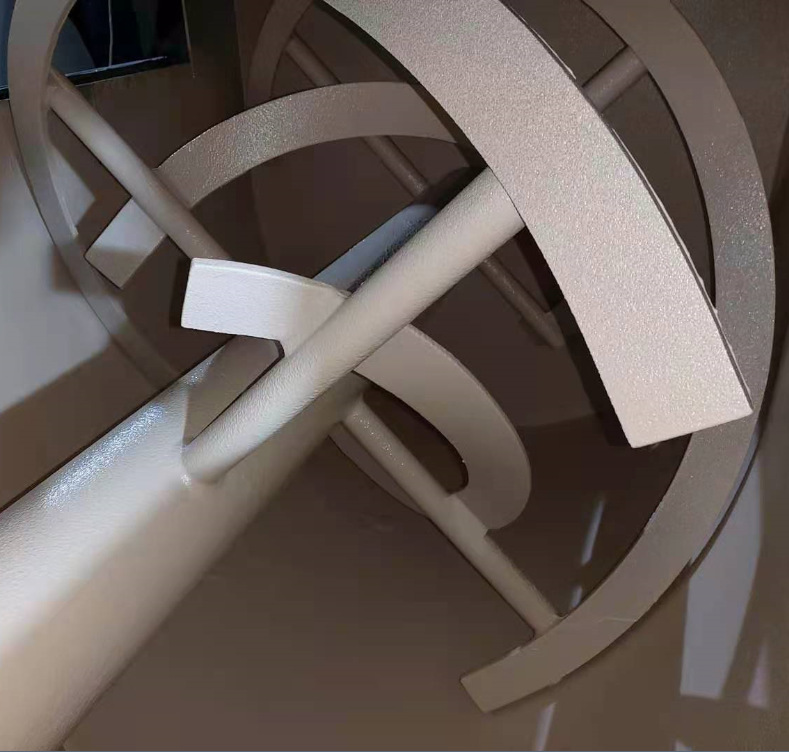
Undertaking the construction of nano-ceramic coatings for lithium-ion battery equipment impeller blades and feeding shafts; ceramic layer coating and processing.
Guangzhou Sanxin Company utilizes American Miller plasma cladding equipment and technology to perform on-site cladding of wear-resistant ceramic coatings. This technology is particularly suitable for hopper, screw, and ribbon mixing and conveying systems in the lithium-ion new energy industry.
纳米陶瓷涂层
喷涂加工
等离子喷涂
Product Description
Undertaking the application of nano-ceramic coatings to lithium-ion battery equipment impeller blades and feeding shafts.
Guangzhou Sanxin Company utilizes American Miller plasma cladding equipment and technology to perform on-site cladding of wear-resistant ceramic coatings, making it suitable for hopper, screw, and ribbon mixing and conveying systems in the lithium-ion new energy industry.
1. Utilizing the American Miller plasma process, a high-temperature plasma arc exceeding 10,000 degrees is generated, directly melting pure ceramics and spraying them onto the substrate at high pressure and high velocity to form a coating that achieves direct metallurgical bonding with the substrate.
2. The coating does not contaminate the powder with chemical components such as epoxy polymers or adhesive binders, and it also contains no metallic constituents, thus avoiding any increase in metallic foreign particle levels. Over the long term, compared to other coatings, this coating significantly reduces the magnetic foreign particle level—by 10 to 50 parts per billion (PPB).
3. The ceramic coating thickness is 0.6–1.8 mm, and production can begin immediately after construction is completed.
On-site Spray Coating Process for Plasma Coatings
1. Clear the site, enclose the construction area, and connect construction equipment to electricity and gas.
2. Sandblasting treatment of the substrate surface to meet or exceed Sa2.5 standard;
3. On-site spray coating construction using plasma cladding;
4. Quality inspection: The composition analyzer checks the material composition and the content of metallic impurities; coating hardness and thickness are also inspected, followed by construction acceptance.



Next: Undertaking coating of new energy equipment: ceramic coatings and tungsten carbide coatings.
Online Quotation
Related products
Spraying equipment SPRAY EQUIPMENT
Undertaking the construction of nano-ceramic coatings for lithium-ion battery equipment impeller blades and feeding shafts; ceramic layer coating and processing.
Guangzhou Sanxin Company utilizes American Miller plasma cladding equipment and technology to perform on-site cladding of wear-resistant ceramic coatings. This technology is particularly suitable for hopper, screw, and ribbon mixing and conveying systems in the lithium-ion new energy industry.
纳米陶瓷涂层
喷涂加工
等离子喷涂
Product Description
Undertaking the application of nano-ceramic coatings to lithium-ion battery equipment impeller blades and feeding shafts.
Guangzhou Sanxin Company utilizes American Miller plasma cladding equipment and technology to perform on-site cladding of wear-resistant ceramic coatings, making it suitable for hopper, screw, and ribbon mixing and conveying systems in the lithium-ion new energy industry.
1. Utilizing the American Miller plasma process, a high-temperature plasma arc exceeding 10,000 degrees is generated, directly melting pure ceramics and spraying them onto the substrate at high pressure and high velocity to form a coating that achieves direct metallurgical bonding with the substrate.
2. The coating does not contaminate the powder with chemical components such as epoxy polymers or adhesive binders, and it also contains no metallic constituents, thus avoiding any increase in metallic foreign particle levels. Over the long term, compared to other coatings, this coating significantly reduces the magnetic foreign particle level—by 10 to 50 parts per billion (PPB).
3. The ceramic coating thickness is 0.6–1.8 mm, and production can begin immediately after construction is completed.
On-site Spray Coating Process for Plasma Coatings
1. Clear the site, enclose the construction area, and connect construction equipment to electricity and gas.
2. Sandblasting treatment of the substrate surface to meet or exceed Sa2.5 standard;
3. On-site spray coating construction using plasma cladding;
4. Quality inspection: The composition analyzer checks the material composition and the content of metallic impurities; coating hardness and thickness are also inspected, followed by construction acceptance.
Next: Undertaking coating of new energy equipment: ceramic coatings and tungsten carbide coatings.
Online Quotation
Exclusive customized hotline, 24 hours a day, 7 days a week:
Email:CarrieFeng07@outlook.com
Address: Building 8, Liandong U Valley Guangzhou Nansha International Enterprise Port, Nansha Free Trade Zone, Guangzhou City, Guangdong Province


Copyright © 2023 Guangzhou Sanxin Metal Technology Co., Ltd. All Rights Reserved
Powered by www.300.cn


