Welcome to the official website of Guangzhou Sanxin Metal Technology Co., Ltd.!


Selection of Arc Spraying Process Parameters
Release time:
2019-12-12 16:57
Source:

Based on the characteristics and requirements of arc spraying technology, the main process parameters for arc-spraying operations can be summarized into four key factors: arc voltage, working current, atomizing air pressure, and spray distance. The correctness and rationality of the selected process parameters directly affect the stability of the arc-spraying process, coating quality, spraying speed, and deposition efficiency; therefore, it is crucial to select process parameters appropriately.
For operators, controlling these parameters during spraying is easy—just a short training period is all it takes to become proficient in operating the equipment and producing coatings of consistent quality.
1. Spraying voltage
The spraying voltage refers to the arc voltage between the two metal wires during the spraying process. In arc spraying, the two metal wires are fed evenly into the spray gun, where an arc is generated at the tips of the wires at the front end of the gun. To obtain a coating with stable performance and reliable quality, it is essential to maintain a consistently stable arc voltage. The arc voltage serves as a measure of the distance between the wire tips; effectively controlling this parameter ensures the geometric stability of the atomization zone. Therefore, arc-spray equipment commonly used today typically requires a power supply with a flat volt-ampere characteristic. The arc voltage influences the stability of arc combustion, and each material has its own minimum arc voltage value necessary for stable arc burning. The lower the arc voltage, the smaller the size of the molten particles and the narrower their size distribution. If the arc voltage falls below the material's critical minimum arc voltage, the arc will no longer burn stably, leading to intermittent contact between the wires. This results in irregular arc interruptions and re-ignitions, producing large chunks of incompletely melted wire segments—and in some cases, even causing two wires to weld together in parallel. At such times, the ammeter reading fluctuates violently, sometimes even exceeding the ammeter’s measurement range.
The critical arc voltage of a material is primarily related to its melting point. Generally speaking, materials with lower melting points have lower critical arc voltages, whereas materials with higher melting points exhibit higher critical arc voltages. In addition to being influenced by the material’s melting point, the resistivity of the oxide film on the wire surface also affects the material’s critical arc voltage. For example, pure aluminum has a melting point of 667°C, and its spray-arc voltage requirement is between 30 and 32 V—this value is comparable to that required for steel wires with a melting point of 1500°C. The higher voltage requirement for spraying aluminum wire stems from the relatively high resistivity of the oxide film on its surface, which results in poor conductivity and necessitates a higher voltage to maintain arc stability.
When the spraying voltage exceeds the critical arc voltage, as the arc voltage increases, the distance between the wire tips grows larger, the angle of the spray jet increases, and the particle size distribution of the sprayed particles broadens. Figure 1 illustrates the effect of arc voltage on the atomization and distribution of sprayed particles. As the arc voltage rises, the tendency for elemental burn-off in the sprayed material increases—particularly for elements that readily combine with oxygen, which suffer even more significant elemental loss.

For example, when arc spraying 4Cr13 wire containing 0.36% carbon, if an arc voltage of 31 V, a working current of 160 A, an atomizing air pressure of 0.45 MPa, and a spray distance of 150 mm are selected, the resulting coating has a carbon content of 0.22% and a hardness of HV 390. Compared to the original wire, the carbon loss due to burning amounts to approximately 40%. Under the same other conditions, when the arc voltage is increased to 34 V, the coating’s carbon content drops to 0.16%, its hardness decreases to HV 328, and the carbon loss rises to about 55%. If the arc voltage is further increased to 37 V, the coating’s carbon content is reduced to only 0.11%, and its hardness falls to HV 298. As these results show, the arc voltage significantly affects the quality of the sprayed coating. To obtain a high-quality coating, while ensuring stable arc combustion, it is essential to select the lowest possible arc voltage value. The higher the arc voltage, the longer the arc length; this means that, under the condition of maintaining arc stability, the allowable deviation in the intersection point of the two metal wires at the nozzle of the spray gun can be greater. During the spraying process, this property of the arc is sometimes exploited: when the conductive tube wears out and no spare conductive tube is available for replacement, the arc can be stabilized by increasing the voltage. Of course, using this emergency method will inevitably affect the quality of the atomized coating. Table 1 lists the operating arc voltages for spraying various materials.
Table 1: Operating Voltage for Spraying Some Materials
|
Materials |
Operating Voltage/V |
Materials |
Operating Voltage/V |
|
Zinc |
26~28 |
Carbon steel and stainless steel |
30~32 |
|
Aluminum |
30~32 |
Tin alloy |
23~25 |
|
Zinc-aluminum alloy |
28~30 |
Nickel alloy |
30~33 |
|
Aluminum-magnesium alloy |
30~32 |
Copper alloy |
29~32 |
|
Rare-earth aluminum alloy |
30~32 |
Aluminum bronze (bonding layer) |
34~38 |
|
Zinc-aluminum pseudo-alloy |
28~30 |
Nickel-aluminum alloy (bonding layer) |
34~38 |
When arc-spraying self-bonding materials is used as a primer layer, the arc voltage cannot be selected based on the principles mentioned above. In such cases, appropriately increasing the spraying voltage can produce coarser spray particles with greater overheating, enabling them to carry more heat and facilitating oxidation and exothermic reactions within the particles. When these particles impact the substrate surface, the thoroughly heated, coarse particles are more likely to undergo micro-metallurgical bonding with the substrate surface, thereby enhancing the bond strength between the coating and the substrate and improving the reliability of the surface working layer’s adhesion.
2. Operating current
In arc-spray equipment with flat characteristics, the spraying current is directly controlled by the wire-feed speed. As the wire-feed speed increases, the gap at the wire tip decreases. Since the spacing between wires is determined by the arc voltage, and the power supply has an automatic feature to maintain a stable arc voltage, the only way to restore this balance is by increasing the output power—that is, by boosting the working current—to ensure that the wire melts more rapidly. The working current is directly proportional to the wire-feed speed; in other words, the working current serves as a measure of spray-production efficiency. From a microscopic perspective, this characteristic of the power supply is also highly significant. If, for some reason, the wire-feed speed undergoes even a slight change during the spraying process, the power supply will automatically adjust the power required to melt the wire. This property of arc spraying distinguishes it from flame spraying: in flame spraying, the energy output does not automatically adjust in response to changes in the wire-feed rate, which inevitably affects the degree of material melting.
Increasing the working current not only enhances spray coating production efficiency but also improves coating quality. Table 2 shows the oxide content and porosity of Cr13 martensitic stainless steel coatings measured under the conditions of an atomizing air pressure of 0.5 MPa and a spray distance of 125 mm, with different working currents selected.
Table 2: Effect of Operating Current on Oxide Content and Porosity in the Coating
|
Operating current /A |
Production capacity /kg·h⁻¹ |
Porosity / % |
Oxide content /% |
|
50 |
1.14 |
4.29 |
8.48 |
|
100 |
2.27 |
2.47 |
11.80 |
|
200 |
4.54 |
1.96 |
9.33 |
|
300 |
8.0 |
1.79 |
6.56 |
A higher working current can produce high-quality coatings; however, the upper limit of the working current is often constrained by the capacity of the arc-spraying equipment. When the working current falls below a certain value, the arc cannot burn stably. The minimum working current value depends not only on the material but also on the cross-sectional size of the wire. For wires of specific specifications, each material has its own corresponding minimum working current value.
3. Atomized air
The pressure of the atomizing air significantly determines the degree of atomization and the flight velocity of the sprayed particles, and it also affects the performance of the coating. Under the same atomizing air pressure, different spray gun designs will produce varying atomization effects. A well-designed spray gun should concentrate the atomizing airflow precisely at the tip of the molten metal wire, where the high-speed airflow shears the molten metal droplets into fine flakes, causing them to detach from the arc zone and undergo further atomization and acceleration. For a specific spray gun, when spraying a particular type of wire, and keeping all other process parameters constant, higher atomizing air pressure will result in a denser coating.
When applying a self-adhesive material by spray coating as an adhesive primer, it is generally not desirable to use excessively high atomizing air pressure in order to achieve a fine, dense coating. On the contrary, slightly coarser spray particles can carry more heat, which is more conducive to the formation of micro-metallurgical bonding with the substrate.
Sometimes, for certain low-melting-point materials, excessively high atomizing air pressure is also undesirable. This is because, with a lower melting point, higher atomizing pressure will result in finer molten droplets, accelerating both the oxidation and cooling of these droplets. Before the spray particle stream reaches the surface of the workpiece, many of the finer or heavily oxidized droplets have already solidified and hardened. When these droplets impact the workpiece surface, they tend to bounce off, thereby reducing the deposition rate of the coating. For example, this phenomenon can be clearly observed when spraying zinc coatings.
Compressed air is the most cost-effective source of atomizing gas. In large-scale anti-corrosion coating applications for steel structures, compressed air is primarily used as the atomizing gas. To prevent excessive oxidation of certain materials, nitrogen gas can sometimes be employed as the atomizing gas, yielding coatings that are highly dense and contain very low levels of oxides. Moreover, the mechanical properties of these coatings are significantly improved. However, since arc spraying consumes large quantities of gas, the extensive use of bottled nitrogen poses economic and logistical challenges, thereby limiting its application.
4. Spray distance
The spray distance refers to the distance between the spray gun and the surface of the workpiece. After being melted in the arc zone, the metal wire is atomized and accelerated by an atomizing air stream, then impacts the workpiece surface to form a coating. At the nozzle of the spray gun, the compressed air flow reaches its maximum velocity, while the molten droplets have the lowest velocity. As the spray distance increases, the sprayed particles gradually accelerate. At the same time, the velocity of the atomizing air flow gradually decreases. For example, when spraying steel wire, the sprayed particles reach their highest flight velocity at a distance of approximately 50 mm. Due to air resistance and the weakening of the accelerating air flow, the flight velocity of the sprayed particles begins to decline. According to the principles of fluid mechanics, under given atomizing gas pressure and flow rate, the flight velocity of the particles depends on their size. After being ejected from the spray gun, the molten metal is atomized and accelerated; because the particles differ in size, they experience varying degrees of acceleration. Figure 2 shows the relationship between the atomizing air flow velocity and the flight velocity of sprayed particles of different sizes as a function of spray distance during arc spraying of carbon steel coatings.
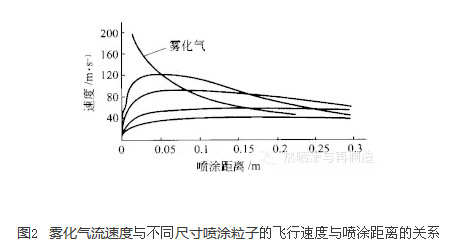
As shown in Figure 2, the sprayed particles exhibit relatively high flight velocities within a spraying distance of 50 to 200 mm. To obtain a high-quality coating, it is not only necessary for the sprayed particles to have high flight velocities but also essential that they possess sufficiently high temperatures, enabling them to be in a molten or softened state. This ensures that, upon impact with the substrate surface, the particles can deform adequately, allowing individual spray particles to interlock effectively and thus providing the coating with sufficient cohesive strength and bonding strength. Figure 3 illustrates the effect of spraying distance on the bonding strength of the 3Crl3 coating.
During the spraying process, spray particles that are in a highly overheated state are extremely prone to oxidation due to their large specific surface area. The finer the particle size, the greater the specific surface area per unit volume, and thus the more opportunities there are for these particles to combine with oxygen. Within a typical spraying distance, spray particles take only 1 to 2 milliseconds to reach the surface of the workpiece. Although the particles spend only a brief amount of time flying through the air, owing to their large specific surface area and ample supply of oxygen, oxidation often occurs quite severely. For steel materials, the oxidation process can have numerous adverse effects on the coating, such as carbon loss, increased oxide content, and higher porosity. Among these, changes in carbon content directly affect the mechanical properties of the coating. Figure 4 shows the effect of spraying distance on the oxide content and porosity of the 3Crl3 coating.


For corrosion-resistant coatings such as arc-sprayed zinc or arc-sprayed aluminum, the commonly recommended spray distance is between 150 and 250 mm. Within this range, the sprayed particles can achieve sufficiently high flight velocities and particle temperatures, resulting in coatings with excellent coating quality and mechanical properties. As the spray distance increases, some particles with lower flight velocities and others that have undergone severe oxidation lose sufficient kinetic energy and plasticity, making it impossible for them to deposit onto the substrate and thus reducing the coating deposition efficiency. Since the spray particle stream exiting the gun generally takes on a conical shape, the cone base widens as the distance from the gun increases. During large-area corrosion protection applications, a slightly greater spray distance can help improve the uniformity of the coating deposition; however, care must be taken not to set the distance too large, as this could significantly reduce both the coating's bonding strength and deposition rate.
Based on the characteristics and requirements of arc spraying technology, the main process parameters for arc-spraying operations can be summarized into four key factors: arc voltage, working current, atomizing air pressure, and spray distance. The correctness and rationality of the selected process parameters directly affect the stability of the arc-spraying process, coating quality, spraying speed, and deposition efficiency; therefore, it is crucial to select process parameters appropriately.
For operators, controlling these parameters during spraying is easy—just a short training period is all it takes to become proficient in operating the equipment and producing coatings of consistent quality.
1. Spraying voltage
The spraying voltage refers to the arc voltage between the two metal wires during the spraying process. In arc spraying, the two metal wires are fed evenly into the spray gun, where an arc is generated at the tips of the wires at the front end of the gun. To obtain a coating with stable performance and reliable quality, it is essential to maintain a consistently stable arc voltage. The arc voltage serves as a measure of the distance between the wire tips; effectively controlling this parameter ensures the geometric stability of the atomization zone. Therefore, arc-spray equipment commonly used today typically requires a power supply with a flat volt-ampere characteristic. The arc voltage influences the stability of arc combustion, and each material has its own minimum arc voltage value necessary for stable arc burning. The lower the arc voltage, the smaller the size of the molten particles and the narrower their size distribution. If the arc voltage falls below the material's critical minimum arc voltage, the arc will no longer burn stably, leading to intermittent contact between the wires. This results in irregular arc interruptions and re-ignitions, producing large chunks of incompletely melted wire segments—and in some cases, even causing two wires to weld together in parallel. At such times, the ammeter reading fluctuates violently, sometimes even exceeding the ammeter’s measurement range.
The critical arc voltage of a material is primarily related to its melting point. Generally speaking, materials with lower melting points have lower critical arc voltages, whereas materials with higher melting points exhibit higher critical arc voltages. In addition to being influenced by the material’s melting point, the resistivity of the oxide film on the wire surface also affects the material’s critical arc voltage. For example, pure aluminum has a melting point of 667°C, and its spray-arc voltage requirement is between 30 and 32 V—this value is comparable to that required for steel wires with a melting point of 1500°C. The higher voltage requirement for spraying aluminum wire stems from the relatively high resistivity of the oxide film on its surface, which results in poor conductivity and necessitates a higher voltage to maintain arc stability.
When the spraying voltage exceeds the critical arc voltage, as the arc voltage increases, the distance between the wire tips grows larger, the angle of the spray jet increases, and the particle size distribution of the sprayed particles broadens. Figure 1 illustrates the effect of arc voltage on the atomization and distribution of sprayed particles. As the arc voltage rises, the tendency for elemental burn-off in the sprayed material increases—particularly for elements that readily combine with oxygen, which suffer even more significant elemental loss.
For example, when arc spraying 4Cr13 wire containing 0.36% carbon, if an arc voltage of 31 V, a working current of 160 A, an atomizing air pressure of 0.45 MPa, and a spray distance of 150 mm are selected, the resulting coating has a carbon content of 0.22% and a hardness of HV 390. Compared to the original wire, the carbon loss due to burning amounts to approximately 40%. Under the same other conditions, when the arc voltage is increased to 34 V, the coating’s carbon content drops to 0.16%, its hardness decreases to HV 328, and the carbon loss rises to about 55%. If the arc voltage is further increased to 37 V, the coating’s carbon content is reduced to only 0.11%, and its hardness falls to HV 298. As these results show, the arc voltage significantly affects the quality of the sprayed coating. To obtain a high-quality coating, while ensuring stable arc combustion, it is essential to select the lowest possible arc voltage value. The higher the arc voltage, the longer the arc length; this means that, under the condition of maintaining arc stability, the allowable deviation in the intersection point of the two metal wires at the nozzle of the spray gun can be greater. During the spraying process, this property of the arc is sometimes exploited: when the conductive tube wears out and no spare conductive tube is available for replacement, the arc can be stabilized by increasing the voltage. Of course, using this emergency method will inevitably affect the quality of the atomized coating. Table 1 lists the operating arc voltages for spraying various materials.
Table 1: Operating Voltage for Spraying Some Materials
|
Materials |
Operating Voltage/V |
Materials |
Operating Voltage/V |
|
Zinc |
26~28 |
Carbon steel and stainless steel |
30~32 |
|
Aluminum |
30~32 |
Tin alloy |
23~25 |
|
Zinc-aluminum alloy |
28~30 |
Nickel alloy |
30~33 |
|
Aluminum-magnesium alloy |
30~32 |
Copper alloy |
29~32 |
|
Rare-earth aluminum alloy |
30~32 |
Aluminum bronze (bonding layer) |
34~38 |
|
Zinc-aluminum pseudo-alloy |
28~30 |
Nickel-aluminum alloy (bonding layer) |
34~38 |
When arc-spraying self-bonding materials is used as a primer layer, the arc voltage cannot be selected based on the principles mentioned above. In such cases, appropriately increasing the spraying voltage can produce coarser spray particles with greater overheating, enabling them to carry more heat and facilitating oxidation and exothermic reactions within the particles. When these particles impact the substrate surface, the thoroughly heated, coarse particles are more likely to undergo micro-metallurgical bonding with the substrate surface, thereby enhancing the bond strength between the coating and the substrate and improving the reliability of the surface working layer’s adhesion.
2. Operating current
In arc-spray equipment with flat characteristics, the spraying current is directly controlled by the wire-feed speed. As the wire-feed speed increases, the gap at the wire tip decreases. Since the spacing between wires is determined by the arc voltage, and the power supply has an automatic feature to maintain a stable arc voltage, the only way to restore this balance is by increasing the output power—that is, by boosting the working current—to ensure that the wire melts more rapidly. The working current is directly proportional to the wire-feed speed; in other words, the working current serves as a measure of spray-production efficiency. From a microscopic perspective, this characteristic of the power supply is also highly significant. If, for some reason, the wire-feed speed undergoes even a slight change during the spraying process, the power supply will automatically adjust the power required to melt the wire. This property of arc spraying distinguishes it from flame spraying: in flame spraying, the energy output does not automatically adjust in response to changes in the wire-feed rate, which inevitably affects the degree of material melting.
Increasing the working current not only enhances spray coating production efficiency but also improves coating quality. Table 2 shows the oxide content and porosity of Cr13 martensitic stainless steel coatings measured under the conditions of an atomizing air pressure of 0.5 MPa and a spray distance of 125 mm, with different working currents selected.
Table 2: Effect of Operating Current on Oxide Content and Porosity in the Coating
|
Operating current /A |
Production capacity /kg·h⁻¹ |
Porosity / % |
Oxide content /% |
|
50 |
1.14 |
4.29 |
8.48 |
|
100 |
2.27 |
2.47 |
11.80 |
|
200 |
4.54 |
1.96 |
9.33 |
|
300 |
8.0 |
1.79 |
6.56 |
A higher working current can produce high-quality coatings; however, the upper limit of the working current is often constrained by the capacity of the arc-spraying equipment. When the working current falls below a certain value, the arc cannot burn stably. The minimum working current value depends not only on the material but also on the cross-sectional size of the wire. For wires of specific specifications, each material has its own corresponding minimum working current value.
3. Atomized air
The pressure of the atomizing air significantly determines the degree of atomization and the flight velocity of the sprayed particles, and it also affects the performance of the coating. Under the same atomizing air pressure, different spray gun designs will produce varying atomization effects. A well-designed spray gun should concentrate the atomizing airflow precisely at the tip of the molten metal wire, where the high-speed airflow shears the molten metal droplets into fine flakes, causing them to detach from the arc zone and undergo further atomization and acceleration. For a specific spray gun, when spraying a particular type of wire, and keeping all other process parameters constant, higher atomizing air pressure will result in a denser coating.
When applying a self-adhesive material by spray coating as an adhesive primer, it is generally not desirable to use excessively high atomizing air pressure in order to achieve a fine, dense coating. On the contrary, slightly coarser spray particles can carry more heat, which is more conducive to the formation of micro-metallurgical bonding with the substrate.
Sometimes, for certain low-melting-point materials, excessively high atomizing air pressure is also undesirable. This is because, with a lower melting point, higher atomizing pressure will result in finer molten droplets, accelerating both the oxidation and cooling of these droplets. Before the spray particle stream reaches the surface of the workpiece, many of the finer or heavily oxidized droplets have already solidified and hardened. When these droplets impact the workpiece surface, they tend to bounce off, thereby reducing the deposition rate of the coating. For example, this phenomenon can be clearly observed when spraying zinc coatings.
Compressed air is the most cost-effective source of atomizing gas. In large-scale anti-corrosion coating applications for steel structures, compressed air is primarily used as the atomizing gas. To prevent excessive oxidation of certain materials, nitrogen gas can sometimes be employed as the atomizing gas, yielding coatings that are highly dense and contain very low levels of oxides. Moreover, the mechanical properties of these coatings are significantly improved. However, since arc spraying consumes large quantities of gas, the extensive use of bottled nitrogen poses economic and logistical challenges, thereby limiting its application.
4. Spray distance
The spray distance refers to the distance between the spray gun and the surface of the workpiece. After being melted in the arc zone, the metal wire is atomized and accelerated by an atomizing air stream, then impacts the workpiece surface to form a coating. At the nozzle of the spray gun, the compressed air flow reaches its maximum velocity, while the molten droplets have the lowest velocity. As the spray distance increases, the sprayed particles gradually accelerate. At the same time, the velocity of the atomizing air flow gradually decreases. For example, when spraying steel wire, the sprayed particles reach their highest flight velocity at a distance of approximately 50 mm. Due to air resistance and the weakening of the accelerating air flow, the flight velocity of the sprayed particles begins to decline. According to the principles of fluid mechanics, under given atomizing gas pressure and flow rate, the flight velocity of the particles depends on their size. After being ejected from the spray gun, the molten metal is atomized and accelerated; because the particles differ in size, they experience varying degrees of acceleration. Figure 2 shows the relationship between the atomizing air flow velocity and the flight velocity of sprayed particles of different sizes as a function of spray distance during arc spraying of carbon steel coatings.
As shown in Figure 2, the sprayed particles exhibit relatively high flight velocities within a spraying distance of 50 to 200 mm. To obtain a high-quality coating, it is not only necessary for the sprayed particles to have high flight velocities but also essential that they possess sufficiently high temperatures, enabling them to be in a molten or softened state. This ensures that, upon impact with the substrate surface, the particles can deform adequately, allowing individual spray particles to interlock effectively and thus providing the coating with sufficient cohesive strength and bonding strength. Figure 3 illustrates the effect of spraying distance on the bonding strength of the 3Crl3 coating.
During the spraying process, spray particles that are in a highly overheated state are extremely prone to oxidation due to their large specific surface area. The finer the particle size, the greater the specific surface area per unit volume, and thus the more opportunities there are for these particles to combine with oxygen. Within a typical spraying distance, spray particles take only 1 to 2 milliseconds to reach the surface of the workpiece. Although the particles spend only a brief amount of time flying through the air, owing to their large specific surface area and ample supply of oxygen, oxidation often occurs quite severely. For steel materials, the oxidation process can have numerous adverse effects on the coating, such as carbon loss, increased oxide content, and higher porosity. Among these, changes in carbon content directly affect the mechanical properties of the coating. Figure 4 shows the effect of spraying distance on the oxide content and porosity of the 3Crl3 coating.
For corrosion-resistant coatings such as arc-sprayed zinc or arc-sprayed aluminum, the commonly recommended spray distance is between 150 and 250 mm. Within this range, the sprayed particles can achieve sufficiently high flight velocities and particle temperatures, resulting in coatings with excellent coating quality and mechanical properties. As the spray distance increases, some particles with lower flight velocities and others that have undergone severe oxidation lose sufficient kinetic energy and plasticity, making it impossible for them to deposit onto the substrate and thus reducing the coating deposition efficiency. Since the spray particle stream exiting the gun generally takes on a conical shape, the cone base widens as the distance from the gun increases. During large-area corrosion protection applications, a slightly greater spray distance can help improve the uniformity of the coating deposition; however, care must be taken not to set the distance too large, as this could significantly reduce both the coating's bonding strength and deposition rate.
Based on the characteristics and requirements of arc spraying technology, the main process parameters for arc-spraying operations can be summarized into four key factors: arc voltage, working current, atomizing air pressure, and spray distance. The correctness and rationality of the selected process parameters directly affect the stability of the arc-spraying process, coating quality, spraying speed, and deposition efficiency; therefore, it is crucial to select process parameters appropriately.
For operators, controlling these parameters during spraying is easy—just a short training period is all it takes to become proficient in operating the equipment and producing coatings of consistent quality.
1. Spraying voltage
The spraying voltage refers to the arc voltage between the two metal wires during the spraying process. In arc spraying, the two metal wires are fed evenly into the spray gun, where an arc is generated at the tips of the wires at the front end of the gun. To obtain a coating with stable performance and reliable quality, it is essential to maintain a consistently stable arc voltage. The arc voltage serves as a measure of the distance between the wire tips; effectively controlling this parameter ensures the geometric stability of the atomization zone. Therefore, arc-spray equipment commonly used today typically requires a power supply with a flat volt-ampere characteristic. The arc voltage influences the stability of arc combustion, and each material has its own minimum arc voltage value necessary for stable arc burning. The lower the arc voltage, the smaller the size of the molten particles and the narrower their size distribution. If the arc voltage falls below the material's critical minimum arc voltage, the arc will no longer burn stably, leading to intermittent contact between the wires. This results in irregular arc interruptions and re-ignitions, producing large chunks of incompletely melted wire segments—and in some cases, even causing two wires to weld together in parallel. At such times, the ammeter reading fluctuates violently, sometimes even exceeding the ammeter’s measurement range.
The critical arc voltage of a material is primarily related to its melting point. Generally speaking, materials with lower melting points have lower critical arc voltages, whereas materials with higher melting points exhibit higher critical arc voltages. In addition to being influenced by the material’s melting point, the resistivity of the oxide film on the wire surface also affects the material’s critical arc voltage. For example, pure aluminum has a melting point of 667°C, and its spray-arc voltage requirement is between 30 and 32 V—this value is comparable to that required for steel wires with a melting point of 1500°C. The higher voltage requirement for spraying aluminum wire stems from the relatively high resistivity of the oxide film on its surface, which results in poor conductivity and necessitates a higher voltage to maintain arc stability.
When the spraying voltage exceeds the critical arc voltage, as the arc voltage increases, the distance between the wire tips grows larger, the angle of the spray jet increases, and the particle size distribution of the sprayed particles broadens. Figure 1 illustrates the effect of arc voltage on the atomization and distribution of sprayed particles. As the arc voltage rises, the tendency for elemental burn-off in the sprayed material increases—particularly for elements that readily combine with oxygen, which suffer even more significant elemental loss.
For example, when arc spraying 4Cr13 wire containing 0.36% carbon, if an arc voltage of 31 V, a working current of 160 A, an atomizing air pressure of 0.45 MPa, and a spray distance of 150 mm are selected, the resulting coating has a carbon content of 0.22% and a hardness of HV 390. Compared to the original wire, the carbon loss due to burning amounts to approximately 40%. Under the same other conditions, when the arc voltage is increased to 34 V, the coating’s carbon content drops to 0.16%, its hardness decreases to HV 328, and the carbon loss rises to about 55%. If the arc voltage is further increased to 37 V, the coating’s carbon content is reduced to only 0.11%, and its hardness falls to HV 298. As these results show, the arc voltage significantly affects the quality of the sprayed coating. To obtain a high-quality coating, while ensuring stable arc combustion, it is essential to select the lowest possible arc voltage value. The higher the arc voltage, the longer the arc length; this means that, under the condition of maintaining arc stability, the allowable deviation in the intersection point of the two metal wires at the nozzle of the spray gun can be greater. During the spraying process, this property of the arc is sometimes exploited: when the conductive tube wears out and no spare conductive tube is available for replacement, the arc can be stabilized by increasing the voltage. Of course, using this emergency method will inevitably affect the quality of the atomized coating. Table 1 lists the operating arc voltages for spraying various materials.
Table 1: Operating Voltage for Spraying Some Materials
|
Materials |
Operating Voltage/V |
Materials |
Operating Voltage/V |
|
Zinc |
26~28 |
Carbon steel and stainless steel |
30~32 |
|
Aluminum |
30~32 |
Tin alloy |
23~25 |
|
Zinc-aluminum alloy |
28~30 |
Nickel alloy |
30~33 |
|
Aluminum-magnesium alloy |
30~32 |
Copper alloy |
29~32 |
|
Rare-earth aluminum alloy |
30~32 |
Aluminum bronze (bonding layer) |
34~38 |
|
Zinc-aluminum pseudo-alloy |
28~30 |
Nickel-aluminum alloy (bonding layer) |
34~38 |
When arc-spraying self-bonding materials is used as a primer layer, the arc voltage cannot be selected based on the principles mentioned above. In such cases, appropriately increasing the spraying voltage can produce coarser spray particles with greater overheating, enabling them to carry more heat and facilitating oxidation and exothermic reactions within the particles. When these particles impact the substrate surface, the thoroughly heated, coarse particles are more likely to undergo micro-metallurgical bonding with the substrate surface, thereby enhancing the bond strength between the coating and the substrate and improving the reliability of the surface working layer’s adhesion.
2. Operating current
In arc-spray equipment with flat characteristics, the spraying current is directly controlled by the wire-feed speed. As the wire-feed speed increases, the gap at the wire tip decreases. Since the spacing between wires is determined by the arc voltage, and the power supply has an automatic feature to maintain a stable arc voltage, the only way to restore this balance is by increasing the output power—that is, by boosting the working current—to ensure that the wire melts more rapidly. The working current is directly proportional to the wire-feed speed; in other words, the working current serves as a measure of spray-production efficiency. From a microscopic perspective, this characteristic of the power supply is also highly significant. If, for some reason, the wire-feed speed undergoes even a slight change during the spraying process, the power supply will automatically adjust the power required to melt the wire. This property of arc spraying distinguishes it from flame spraying: in flame spraying, the energy output does not automatically adjust in response to changes in the wire-feed rate, which inevitably affects the degree of material melting.
Increasing the working current not only enhances spray coating production efficiency but also improves coating quality. Table 2 shows the oxide content and porosity of Cr13 martensitic stainless steel coatings measured under the conditions of an atomizing air pressure of 0.5 MPa and a spray distance of 125 mm, with different working currents selected.
Table 2: Effect of Operating Current on Oxide Content and Porosity in the Coating
|
Operating current /A |
Production capacity /kg·h⁻¹ |
Porosity / % |
Oxide content /% |
|
50 |
1.14 |
4.29 |
8.48 |
|
100 |
2.27 |
2.47 |
11.80 |
|
200 |
4.54 |
1.96 |
9.33 |
|
300 |
8.0 |
1.79 |
6.56 |
A higher working current can produce high-quality coatings; however, the upper limit of the working current is often constrained by the capacity of the arc-spraying equipment. When the working current falls below a certain value, the arc cannot burn stably. The minimum working current value depends not only on the material but also on the cross-sectional size of the wire. For wires of specific specifications, each material has its own corresponding minimum working current value.
3. Atomized air
The pressure of the atomizing air significantly determines the degree of atomization and the flight velocity of the sprayed particles, and it also affects the performance of the coating. Under the same atomizing air pressure, different spray gun designs will produce varying atomization effects. A well-designed spray gun should concentrate the atomizing airflow precisely at the tip of the molten metal wire, where the high-speed airflow shears the molten metal droplets into fine flakes, causing them to detach from the arc zone and undergo further atomization and acceleration. For a specific spray gun, when spraying a particular type of wire, and keeping all other process parameters constant, higher atomizing air pressure will result in a denser coating.
When applying a self-adhesive material by spray coating as an adhesive primer, it is generally not desirable to use excessively high atomizing air pressure in order to achieve a fine, dense coating. On the contrary, slightly coarser spray particles can carry more heat, which is more conducive to the formation of micro-metallurgical bonding with the substrate.
Sometimes, for certain low-melting-point materials, excessively high atomizing air pressure is also undesirable. This is because, with a lower melting point, higher atomizing pressure will result in finer molten droplets, accelerating both the oxidation and cooling of these droplets. Before the spray particle stream reaches the surface of the workpiece, many of the finer or heavily oxidized droplets have already solidified and hardened. When these droplets impact the workpiece surface, they tend to bounce off, thereby reducing the deposition rate of the coating. For example, this phenomenon can be clearly observed when spraying zinc coatings.
Compressed air is the most cost-effective source of atomizing gas. In large-scale anti-corrosion coating applications for steel structures, compressed air is primarily used as the atomizing gas. To prevent excessive oxidation of certain materials, nitrogen gas can sometimes be employed as the atomizing gas, yielding coatings that are highly dense and contain very low levels of oxides. Moreover, the mechanical properties of these coatings are significantly improved. However, since arc spraying consumes large quantities of gas, the extensive use of bottled nitrogen poses economic and logistical challenges, thereby limiting its application.
4. Spray distance
The spray distance refers to the distance between the spray gun and the surface of the workpiece. After being melted in the arc zone, the metal wire is atomized and accelerated by an atomizing air stream, then impacts the workpiece surface to form a coating. At the nozzle of the spray gun, the compressed air flow reaches its maximum velocity, while the molten droplets have the lowest velocity. As the spray distance increases, the sprayed particles gradually accelerate. At the same time, the velocity of the atomizing air flow gradually decreases. For example, when spraying steel wire, the sprayed particles reach their highest flight velocity at a distance of approximately 50 mm. Due to air resistance and the weakening of the accelerating air flow, the flight velocity of the sprayed particles begins to decline. According to the principles of fluid mechanics, under given atomizing gas pressure and flow rate, the flight velocity of the particles depends on their size. After being ejected from the spray gun, the molten metal is atomized and accelerated; because the particles differ in size, they experience varying degrees of acceleration. Figure 2 shows the relationship between the atomizing air flow velocity and the flight velocity of sprayed particles of different sizes as a function of spray distance during arc spraying of carbon steel coatings.
As shown in Figure 2, the sprayed particles exhibit relatively high flight velocities within a spraying distance of 50 to 200 mm. To obtain a high-quality coating, it is not only necessary for the sprayed particles to have high flight velocities but also essential that they possess sufficiently high temperatures, enabling them to be in a molten or softened state. This ensures that, upon impact with the substrate surface, the particles can deform adequately, allowing individual spray particles to interlock effectively and thus providing the coating with sufficient cohesive strength and bonding strength. Figure 3 illustrates the effect of spraying distance on the bonding strength of the 3Crl3 coating.
During the spraying process, spray particles that are in a highly overheated state are extremely prone to oxidation due to their large specific surface area. The finer the particle size, the greater the specific surface area per unit volume, and thus the more opportunities there are for these particles to combine with oxygen. Within a typical spraying distance, spray particles take only 1 to 2 milliseconds to reach the surface of the workpiece. Although the particles spend only a brief amount of time flying through the air, owing to their large specific surface area and ample supply of oxygen, oxidation often occurs quite severely. For steel materials, the oxidation process can have numerous adverse effects on the coating, such as carbon loss, increased oxide content, and higher porosity. Among these, changes in carbon content directly affect the mechanical properties of the coating. Figure 4 shows the effect of spraying distance on the oxide content and porosity of the 3Crl3 coating.
For corrosion-resistant coatings such as arc-sprayed zinc or arc-sprayed aluminum, the commonly recommended spray distance is between 150 and 250 mm. Within this range, the sprayed particles can achieve sufficiently high flight velocities and particle temperatures, resulting in coatings with excellent coating quality and mechanical properties. As the spray distance increases, some particles with lower flight velocities and others that have undergone severe oxidation lose sufficient kinetic energy and plasticity, making it impossible for them to deposit onto the substrate and thus reducing the coating deposition efficiency. Since the spray particle stream exiting the gun generally takes on a conical shape, the cone base widens as the distance from the gun increases. During large-area corrosion protection applications, a slightly greater spray distance can help improve the uniformity of the coating deposition; however, care must be taken not to set the distance too large, as this could significantly reduce both the coating's bonding strength and deposition rate.
Based on the characteristics and requirements of arc spraying technology, the main process parameters for arc-spraying operations can be summarized into four key factors: arc voltage, working current, atomizing air pressure, and spray distance. The correctness and rationality of the selected process parameters directly affect the stability of the arc-spraying process, coating quality, spraying speed, and deposition efficiency; therefore, it is crucial to select process parameters appropriately.
For operators, controlling these parameters during spraying is easy—just a short training period is all it takes to become proficient in operating the equipment and producing coatings of consistent quality.
1. Spraying voltage
The spraying voltage refers to the arc voltage between the two metal wires during the spraying process. In arc spraying, the two metal wires are fed evenly into the spray gun, where an arc is generated at the tips of the wires at the front end of the gun. To obtain a coating with stable performance and reliable quality, it is essential to maintain a consistently stable arc voltage. The arc voltage serves as a measure of the distance between the wire tips; effectively controlling this parameter ensures the geometric stability of the atomization zone. Therefore, arc-spray equipment commonly used today typically requires a power supply with a flat volt-ampere characteristic. The arc voltage influences the stability of arc combustion, and each material has its own minimum arc voltage value necessary for stable arc burning. The lower the arc voltage, the smaller the size of the molten particles and the narrower their size distribution. If the arc voltage falls below the material's critical minimum arc voltage, the arc will no longer burn stably, leading to intermittent contact between the wires. This results in irregular arc interruptions and re-ignitions, producing large chunks of incompletely melted wire segments—and in some cases, even causing two wires to weld together in parallel. At such times, the ammeter reading fluctuates violently, sometimes even exceeding the ammeter’s measurement range.
The critical arc voltage of a material is primarily related to its melting point. Generally speaking, materials with lower melting points have lower critical arc voltages, whereas materials with higher melting points exhibit higher critical arc voltages. In addition to being influenced by the material’s melting point, the resistivity of the oxide film on the wire surface also affects the material’s critical arc voltage. For example, pure aluminum has a melting point of 667°C, and its spray-arc voltage requirement is between 30 and 32 V—this value is comparable to that required for steel wires with a melting point of 1500°C. The higher voltage requirement for spraying aluminum wire stems from the relatively high resistivity of the oxide film on its surface, which results in poor conductivity and necessitates a higher voltage to maintain arc stability.
When the spraying voltage exceeds the critical arc voltage, as the arc voltage increases, the distance between the wire tips grows larger, the angle of the spray jet increases, and the particle size distribution of the sprayed particles broadens. Figure 1 illustrates the effect of arc voltage on the atomization and distribution of sprayed particles. As the arc voltage rises, the tendency for elemental burn-off in the sprayed material increases—particularly for elements that readily combine with oxygen, which suffer even more significant elemental loss.
For example, when arc spraying 4Cr13 wire containing 0.36% carbon, if an arc voltage of 31 V, a working current of 160 A, an atomizing air pressure of 0.45 MPa, and a spray distance of 150 mm are selected, the resulting coating has a carbon content of 0.22% and a hardness of HV 390. Compared to the original wire, the carbon loss due to burning amounts to approximately 40%. Under the same other conditions, when the arc voltage is increased to 34 V, the coating’s carbon content drops to 0.16%, its hardness decreases to HV 328, and the carbon loss rises to about 55%. If the arc voltage is further increased to 37 V, the coating’s carbon content is reduced to only 0.11%, and its hardness falls to HV 298. As these results show, the arc voltage significantly affects the quality of the sprayed coating. To obtain a high-quality coating, while ensuring stable arc combustion, it is essential to select the lowest possible arc voltage value. The higher the arc voltage, the longer the arc length; this means that, under the condition of maintaining arc stability, the allowable deviation in the intersection point of the two metal wires at the nozzle of the spray gun can be greater. During the spraying process, this property of the arc is sometimes exploited: when the conductive tube wears out and no spare conductive tube is available for replacement, the arc can be stabilized by increasing the voltage. Of course, using this emergency method will inevitably affect the quality of the atomized coating. Table 1 lists the operating arc voltages for spraying various materials.
Table 1: Operating Voltage for Spraying Some Materials
|
Materials |
Operating Voltage/V |
Materials |
Operating Voltage/V |
|
Zinc |
26~28 |
Carbon steel and stainless steel |
30~32 |
|
Aluminum |
30~32 |
Tin alloy |
23~25 |
|
Zinc-aluminum alloy |
28~30 |
Nickel alloy |
30~33 |
|
Aluminum-magnesium alloy |
30~32 |
Copper alloy |
29~32 |
|
Rare-earth aluminum alloy |
30~32 |
Aluminum bronze (bonding layer) |
34~38 |
|
Zinc-aluminum pseudo-alloy |
28~30 |
Nickel-aluminum alloy (bonding layer) |
34~38 |
When arc-spraying self-bonding materials is used as a primer layer, the arc voltage cannot be selected based on the principles mentioned above. In such cases, appropriately increasing the spraying voltage can produce coarser spray particles with greater overheating, enabling them to carry more heat and facilitating oxidation and exothermic reactions within the particles. When these particles impact the substrate surface, the thoroughly heated, coarse particles are more likely to undergo micro-metallurgical bonding with the substrate surface, thereby enhancing the bond strength between the coating and the substrate and improving the reliability of the surface working layer’s adhesion.
2. Operating current
In arc-spray equipment with flat characteristics, the spraying current is directly controlled by the wire-feed speed. As the wire-feed speed increases, the gap at the wire tip decreases. Since the spacing between wires is determined by the arc voltage, and the power supply has an automatic feature to maintain a stable arc voltage, the only way to restore this balance is by increasing the output power—that is, by boosting the working current—to ensure that the wire melts more rapidly. The working current is directly proportional to the wire-feed speed; in other words, the working current serves as a measure of spray-production efficiency. From a microscopic perspective, this characteristic of the power supply is also highly significant. If, for some reason, the wire-feed speed undergoes even a slight change during the spraying process, the power supply will automatically adjust the power required to melt the wire. This property of arc spraying distinguishes it from flame spraying: in flame spraying, the energy output does not automatically adjust in response to changes in the wire-feed rate, which inevitably affects the degree of material melting.
Increasing the working current not only enhances spray coating production efficiency but also improves coating quality. Table 2 shows the oxide content and porosity of Cr13 martensitic stainless steel coatings measured under the conditions of an atomizing air pressure of 0.5 MPa and a spray distance of 125 mm, with different working currents selected.
Table 2: Effect of Operating Current on Oxide Content and Porosity in the Coating
|
Operating current /A |
Production capacity /kg·h⁻¹ |
Porosity / % |
Oxide content /% |
|
50 |
1.14 |
4.29 |
8.48 |
|
100 |
2.27 |
2.47 |
11.80 |
|
200 |
4.54 |
1.96 |
9.33 |
|
300 |
8.0 |
1.79 |
6.56 |
A higher working current can produce high-quality coatings; however, the upper limit of the working current is often constrained by the capacity of the arc-spraying equipment. When the working current falls below a certain value, the arc cannot burn stably. The minimum working current value depends not only on the material but also on the cross-sectional size of the wire. For wires of specific specifications, each material has its own corresponding minimum working current value.
3. Atomized air
The pressure of the atomizing air significantly determines the degree of atomization and the flight velocity of the sprayed particles, and it also affects the performance of the coating. Under the same atomizing air pressure, different spray gun designs will produce varying atomization effects. A well-designed spray gun should concentrate the atomizing airflow precisely at the tip of the molten metal wire, where the high-speed airflow shears the molten metal droplets into fine flakes, causing them to detach from the arc zone and undergo further atomization and acceleration. For a specific spray gun, when spraying a particular type of wire, and keeping all other process parameters constant, higher atomizing air pressure will result in a denser coating.
When applying a self-adhesive material by spray coating as an adhesive primer, it is generally not desirable to use excessively high atomizing air pressure in order to achieve a fine, dense coating. On the contrary, slightly coarser spray particles can carry more heat, which is more conducive to the formation of micro-metallurgical bonding with the substrate.
Sometimes, for certain low-melting-point materials, excessively high atomizing air pressure is also undesirable. This is because, with a lower melting point, higher atomizing pressure will result in finer molten droplets, accelerating both the oxidation and cooling of these droplets. Before the spray particle stream reaches the surface of the workpiece, many of the finer or heavily oxidized droplets have already solidified and hardened. When these droplets impact the workpiece surface, they tend to bounce off, thereby reducing the deposition rate of the coating. For example, this phenomenon can be clearly observed when spraying zinc coatings.
Compressed air is the most cost-effective source of atomizing gas. In large-scale anti-corrosion coating applications for steel structures, compressed air is primarily used as the atomizing gas. To prevent excessive oxidation of certain materials, nitrogen gas can sometimes be employed as the atomizing gas, yielding coatings that are highly dense and contain very low levels of oxides. Moreover, the mechanical properties of these coatings are significantly improved. However, since arc spraying consumes large quantities of gas, the extensive use of bottled nitrogen poses economic and logistical challenges, thereby limiting its application.
4. Spray distance
The spray distance refers to the distance between the spray gun and the surface of the workpiece. After being melted in the arc zone, the metal wire is atomized and accelerated by an atomizing air stream, then impacts the workpiece surface to form a coating. At the nozzle of the spray gun, the compressed air flow reaches its maximum velocity, while the molten droplets have the lowest velocity. As the spray distance increases, the sprayed particles gradually accelerate. At the same time, the velocity of the atomizing air flow gradually decreases. For example, when spraying steel wire, the sprayed particles reach their highest flight velocity at a distance of approximately 50 mm. Due to air resistance and the weakening of the accelerating air flow, the flight velocity of the sprayed particles begins to decline. According to the principles of fluid mechanics, under given atomizing gas pressure and flow rate, the flight velocity of the particles depends on their size. After being ejected from the spray gun, the molten metal is atomized and accelerated; because the particles differ in size, they experience varying degrees of acceleration. Figure 2 shows the relationship between the atomizing air flow velocity and the flight velocity of sprayed particles of different sizes as a function of spray distance during arc spraying of carbon steel coatings.
As shown in Figure 2, the sprayed particles exhibit relatively high flight velocities within a spraying distance of 50 to 200 mm. To obtain a high-quality coating, it is not only necessary for the sprayed particles to have high flight velocities but also essential that they possess sufficiently high temperatures, enabling them to be in a molten or softened state. This ensures that, upon impact with the substrate surface, the particles can deform adequately, allowing individual spray particles to interlock effectively and thus providing the coating with sufficient cohesive strength and bonding strength. Figure 3 illustrates the effect of spraying distance on the bonding strength of the 3Crl3 coating.
During the spraying process, spray particles that are in a highly overheated state are extremely prone to oxidation due to their large specific surface area. The finer the particle size, the greater the specific surface area per unit volume, and thus the more opportunities there are for these particles to combine with oxygen. Within a typical spraying distance, spray particles take only 1 to 2 milliseconds to reach the surface of the workpiece. Although the particles spend only a brief amount of time flying through the air, owing to their large specific surface area and ample supply of oxygen, oxidation often occurs quite severely. For steel materials, the oxidation process can have numerous adverse effects on the coating, such as carbon loss, increased oxide content, and higher porosity. Among these, changes in carbon content directly affect the mechanical properties of the coating. Figure 4 shows the effect of spraying distance on the oxide content and porosity of the 3Crl3 coating.
For corrosion-resistant coatings such as arc-sprayed zinc or arc-sprayed aluminum, the commonly recommended spray distance is between 150 and 250 mm. Within this range, the sprayed particles can achieve sufficiently high flight velocities and particle temperatures, resulting in coatings with excellent coating quality and mechanical properties. As the spray distance increases, some particles with lower flight velocities and others that have undergone severe oxidation lose sufficient kinetic energy and plasticity, making it impossible for them to deposit onto the substrate and thus reducing the coating deposition efficiency. Since the spray particle stream exiting the gun generally takes on a conical shape, the cone base widens as the distance from the gun increases. During large-area corrosion protection applications, a slightly greater spray distance can help improve the uniformity of the coating deposition; however, care must be taken not to set the distance too large, as this could significantly reduce both the coating's bonding strength and deposition rate.
Previous page
Next page
Relevant Information
The complete set of plasma-sprayed equipment has been shipped to the customer’s site in Thailand.
Core spraying equipment: SX-80 plasma spray main unit, with a 15,000℃ flame suitable for multiple materials including zirconia and silicon carbide; powder feeding accuracy of ±1%, and coating thickness tolerance ≤ ±5 μm. Environmental protection support system: Customized soundproof booth + pulse dust collector—effectively addressing spray noise pollution while achieving highly efficient dust recovery, compliant with Thai environmental standards. Automated equipment: 6-axis industrial robot + intelligent spray cart, enabling precise spraying of complex workpieces and automated loading/unloading, boosting production efficiency by 40%.
On-site engineers provide hands-on training, focusing on the core operations of plasma spraying equipment such as the SX-80. Sanxin has customized a complete solution for its customers, including an automated spraying robotic arm, a soundproof booth, and a dust removal system—ensuring both high spraying efficiency and compliance with environmental standards.
Guangzhou Sanxin Thermal Spraying Turntable Shipment
Guangzhou Sanxin Company manufactures single-station and multi-station thermal spray turntables, which can be paired with plasma equipment, supersonic equipment, and arc equipment. We offer rapid, customized production tailored to customer requirements and product dimensions. A thermal spray turntable is a high-precision rotary worktable specifically designed for thermal spraying processes—including flame spraying, plasma spraying, and arc spraying. By providing controllable rotational speed and exceptional stability, it ensures uniform coating thickness on the workpiece surface, thereby enhancing spraying efficiency and quality.
SX-80 plasma equipment is being used at a customer site in Russia.
SX-80 plasma equipment is being used at a customer site in Russia.

Exclusive customized hotline, 24 hours a day, 7 days a week:
Email:CarrieFeng07@outlook.com
Address: Building 8, Liandong U Valley Guangzhou Nansha International Enterprise Port, Nansha Free Trade Zone, Guangzhou City, Guangdong Province


Copyright © 2023 Guangzhou Sanxin Metal Technology Co., Ltd. All Rights Reserved
Powered by www.300.cn


